
What Happens After a Psychological Evaluation? Turning results into next steps
Once a psychological evaluation is completed, most parents leave with a report, a set of recommendations, and a general sense of relief that there are answers. What is less clear is what to actually do with all of it once you are back in everyday life.
This is often where families feel stuck. The evaluation explains what is going on, but the next step is figuring out how to translate that information into something usable at home and at school.
This post focuses on that part: what typically happens after the evaluation and how to move from understanding to action.
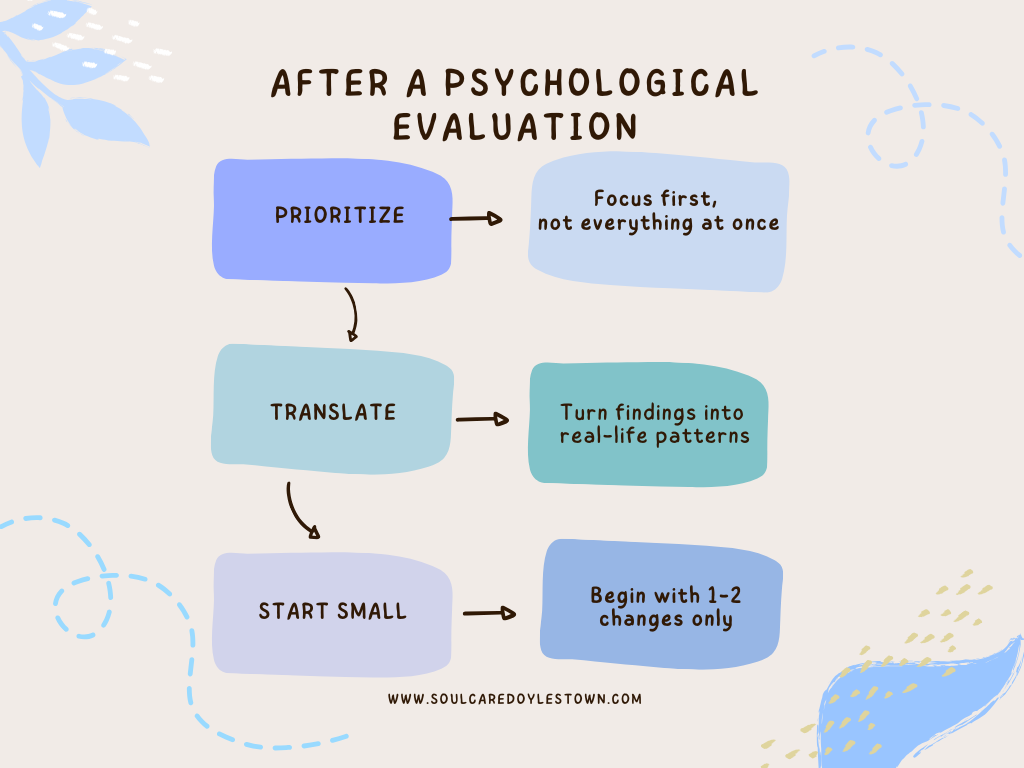
Step 1: Identify what actually matters right now
Most evaluation reports include a range of findings. Not all of them need to be addressed at once.
The first step after receiving results is narrowing the focus. In practice, this usually means identifying:
What is impacting your child most right now at home
What is impacting school functioning or learning
What is causing the most stress or disruption for your child or family
The goal is not to fix everything. The goal is to prioritize what will make the biggest difference first.
Step 2: Translate findings into observable patterns
Test scores and diagnostic language are only useful when they connect to real behavior.
For example:
Difficulty with working memory may show up as forgetting instructions midway through a task
Weak executive functioning may show up as needing repeated prompts to start or finish routines
Emotional regulation challenges may show up as shutdowns, meltdowns, or escalation during transitions
This step is about shifting from “what the report says” to “what I actually see every day.”
A helpful question is:
When does this show up, and what tends to make it better or worse?
Step 3: Start with one or two concrete changes
One of the most common pitfalls after an evaluation is trying to implement every recommendation at once.
This usually leads to overwhelm and inconsistency.
Instead, it is often more effective to choose one or two high-impact changes, such as:
Adjusting a morning or homework routine
Introducing one behavioral support strategy at home
Requesting a specific school accommodation
Starting a targeted therapy or parent coaching focus
Small, consistent changes tend to matter more than broad, unfocused changes.
Step 4: Align home and school supports
When recommendations include school supports, the next step is usually communication with the school team.
This may involve:
Sharing the evaluation report with the school
Requesting a 504 or IEP meeting, if appropriate
Clarifying what accommodations are realistic in the classroom
Making sure home and school are reinforcing similar expectations
Consistency across environments is often what leads to the most meaningful change over time.
Step 5: Expect adjustment, not immediate resolution
It is important to understand that nothing changes immediately after an evaluation. Even when the right supports are identified, it takes time to implement them, adjust them, and see what actually works for a specific child.
It is common to need:
Several weeks to see patterns with new strategies
Adjustments to recommendations once they are in practice
Ongoing support to refine what is working
Evaluations are not static answers. They are starting points for ongoing decision-making.
What often gets overlooked
Many families focus heavily on the diagnosis or the formal recommendations, but the most useful part of the evaluation is often something simpler: understanding context.
Context helps explain:
Why your child may do well in one setting but struggle in another
Why certain strategies work inconsistently
Why behavior changes across time, stress level, or environment
This is what allows recommendations to actually fit real life.
Final thought
A psychological evaluation does not change anything on its own. Its value comes from how the information is applied in daily routines, school planning, and ongoing support.
The most important step after an evaluation is not understanding more. It is choosing where to start.
If you are unsure what to do next after receiving results, that is often the point where brief, focused support can make the biggest difference in turning insight into action.
